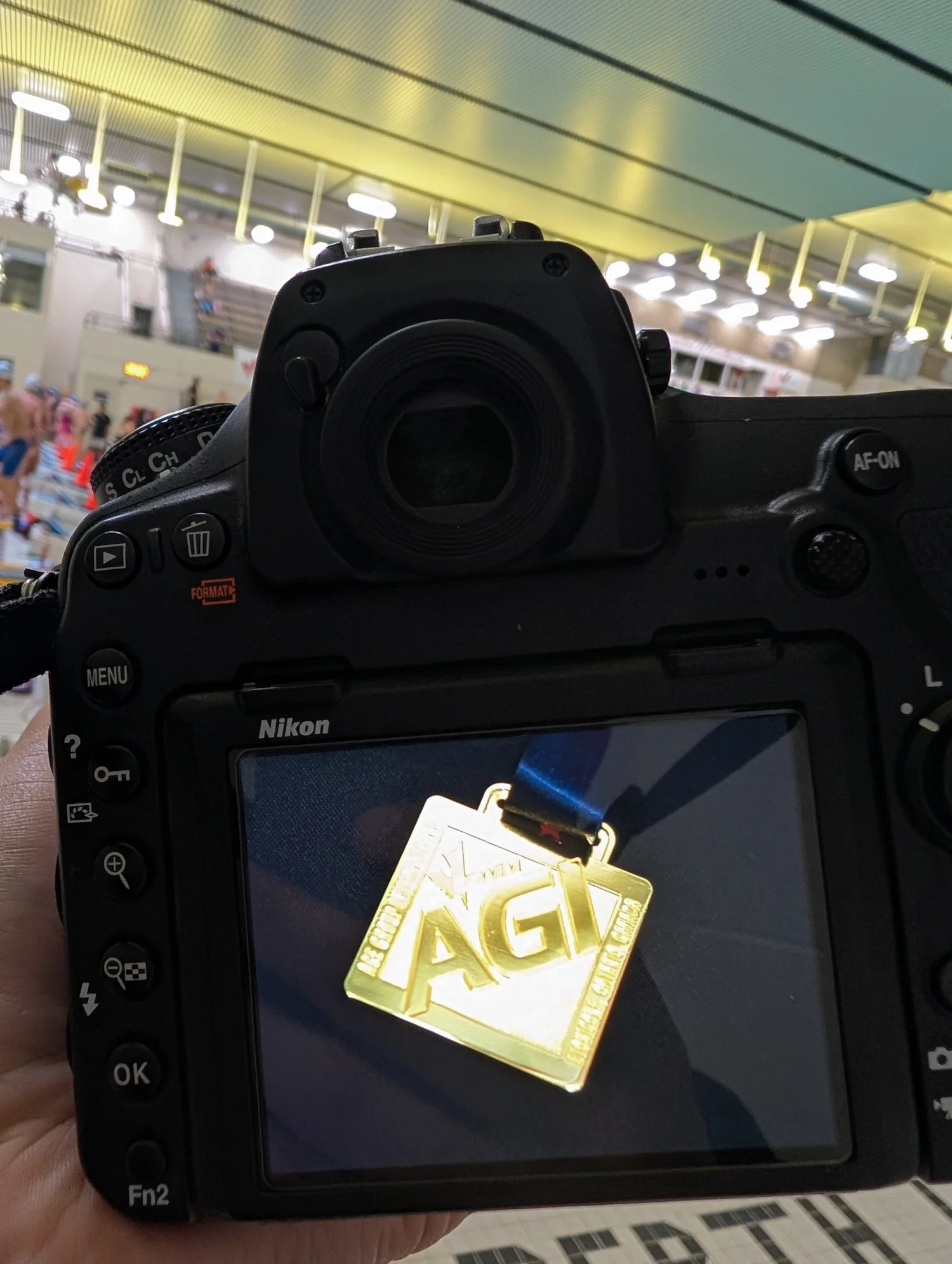
…extending the previous side quest about partnering with AI while photographing swim meets…
The pile is a problem, the reward is more time to be creative.
This is a challenge every event photographer has (in degrees). In my case, a weekend swim meet leaves me with 2,500+ frames. Maybe 100 of them deserve to be seen, 24 can be elevated into my humble variant of “bangers,” and finding those 24 involves mind-numbing work and literally takes the same amount of time as shooting, or more.

I also have spent a decade making the same kinds of edit decisions in Lightroom, over and over, without ever writing down what I was going for.
To be slightly more clear, I’m talking about more than just settings (Lightroom Presets). I also put the painstaking “your level was off by a fraction of a degree, your crop was too wide in that moment and not centered on the swimmer.” That mind-numbing stuff.
Meet Tom
So I built a partner who could learn my “baseline edit taste.” His name is Tom, after Tom Thomson (and the slug of this post is for the Hip fans out there: “Bring on a brand new renaissance, ‘cuz I think I’m ready..“). He’d apparently plan a vocab of concepts he wanted to paint, then go to the wilderness near what is now Algonquin Park looking for the “shot” he wanted to capture. At least that’s what I’m gonna believe and not get in the way of a good metaphor.
Because that’s the point: I should be focused on the joyful stuff, the creativity, the applying of my own style and trying to elevate a few. Every meet I look back at my last meet’s photos and cringe, and figure that’s a good thing; I’m still improving.
Don’t try to replicate Lightroom. Live within it, and extend it.
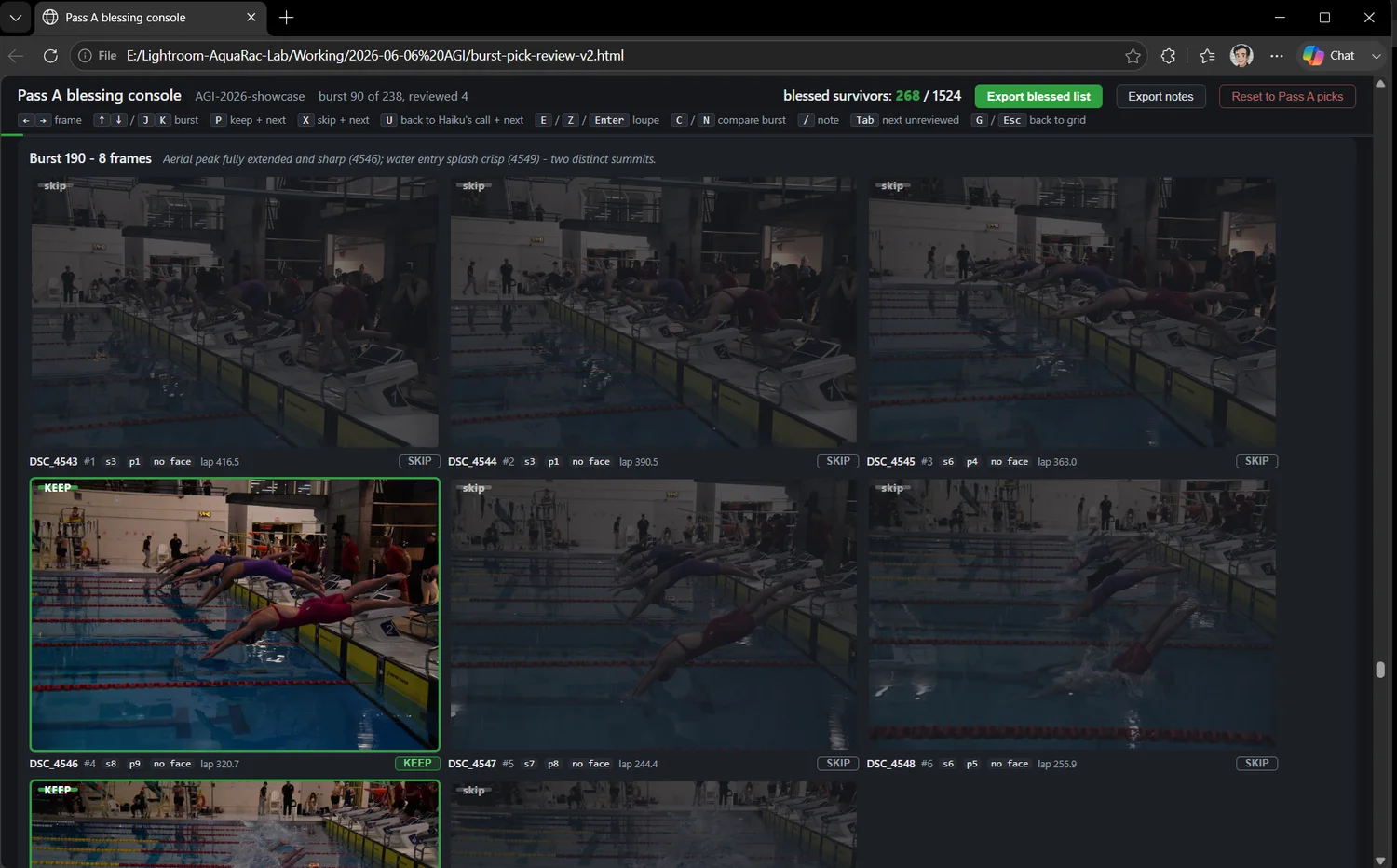
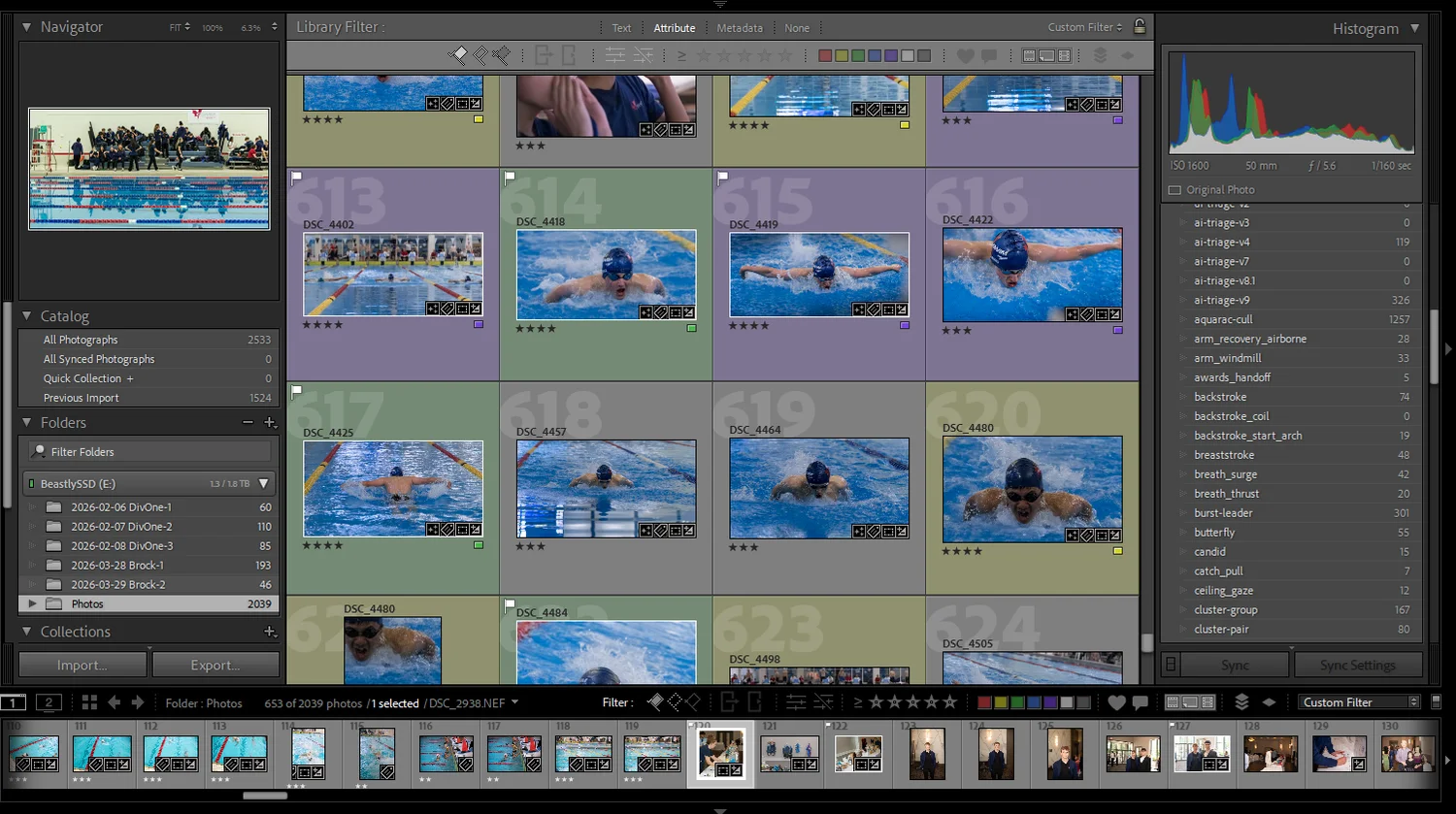
The AI pixie dust lives outside Lightroom. There’s some web UI for that blessing console, I bless the keepers, then there’s a second pass done and I load them into Lightroom. After that the model and I communicate through xmp “sidecar” files, the “.md file of Lightroom,” which allow for nondestructive edits, and labels, which also flow to and from Lightroom. (In other words, the north star is, don’t try to replicate Lightroom, live within it, and extend it).
So again, the two AI-assist passes are:
- A “baseline” layer (currently Haiku) brings mostly mechanics, and a little discretionary smarts, to fix the car-crash white balance and lighting of shots in a venue where flash is prohibited etc., leading to a “blessing” interface where I cull the shots
- The “taste” layer, what style am I going for (currently Sonnet, and I’m experimenting with Gemini here also) I give some slack to do things like maximize symmetry in the framing of a butterfly stroke. Happens to all the shots that make it through the cull, and then we take it to collaboration in Lightroom.
There’s gray area between the two (what is the start of “style” or “taste”?) but I treat them as distinct optimizations. (“I know mind-numbing when I see it.”)
I have no doubt Adobe has thought of this, or something like it. I’m aware of cull assist (as it exists in mid-2026) but this is a different threshold of drudgery I’m mitigating.
Total costs if I’d run a meet through the Apr 2026 Claude API would have been less than $100 for a 2-day meet.
It is very interesting to me to think about (1) how this scales and (2) how I can evolve the system from here.
More to come. [September 2026 edit: Indeed more is coming; Vibe Photography is apparently a thing now]
P.S. The last meet I shot was LITERALLY CALLED AGI – come on universe, that’s a little on the nose, no?!