
Please consider this write-up “in flux” as I capture notes and images. Meanwhile everything’s on GitHub here
Skip the bla bla and play the game here, or visit the LegendWeb
The Part Where I Don’t Have a Time Machine
Ottawa, Canada Day, 1996: I pitch an idea to some fellow Queen’s Engineering “frosh” (first-year students) about making a video game about the Greasepole.. a beautiful, chaotic tradition where first-year Engineers climb a lanolin-greased pole to pull a tam (Scottish hat) from the top.
What I don’t remember happening that day was Future Rob showing up (grey hair etc) saying: “Dude. You’ll build this game with over 50 students, The AI leads you to MIT, the Art Direction takes Craig into film school, and some day, in 2026, an actual AI is going to help you resurrect the game. You’ll basically have a chat, and it writes the code that makes Legend of the Greasepole run on the web. Also, buy Bitcoin.”
That would have been helpful information, but no TARDIS / DeLorean / Circle-K-phone-booth appeared, so I had to find this all out the long way.
50 Students and a Dream (1999)
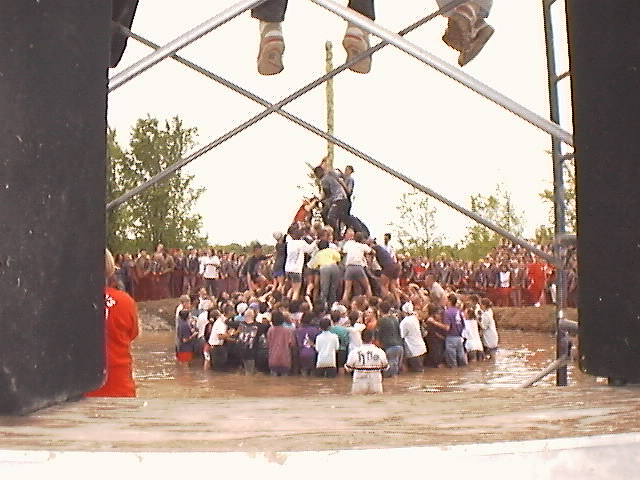
Three years after that pitch, Legend of the Greasepole shipped. Over 50 Queen’s students worked on it: artists, programmers, musicians, testers, voice and visual actors, writers. Craig Calvert was our esteemed Art Director. We burned it on CDs, did a launch party at Clark Hall Pub.
The game captured the spirit, the chaos, the teamwork, the upper-years pretending to be adversaries while secretly rooting for you. We shot with 1990s digital cameras and ran around the mud with a professional Tascam audio recorder. We captured a bunch of warm-spirited and goofy Queen’s traditions: The Golden Words blimp, golden jackets “purpled” with gentian violet, Clark Hall Pub in the background.
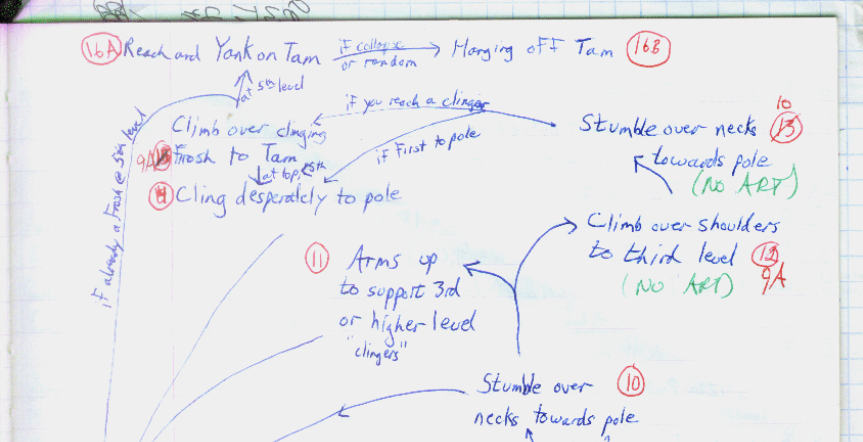
I charged into this not realizing how much AI we’d need to write for the frosh in particular, who need to act autonomously, exhibit (cute) lifelike behaviors, learn and adapt over time, communicate, and ultimately “get better” at climbing the pole. That all required a 1999-era multi-agent architecture that I cobbled together through, let’s be honest, trial and a lot of error.
The Long Sleep (2007-2024)
The game evolved:
2007: Ported to Xbox using XNA Game Studio. C++ to C#. The game ran on consoles through Microsoft’s XNA Creators Club. Look, this was pureplay “labour of love” stuff, done in Visual Studio with a boatload of search and replace to mash code unceremoniously into C#. (If “unceremoniously” also put 100th Meridian in your head, we have an understanding)
2010: Ported again to Silverlight, Microsoft’s browser plugin. For years, you could play Greasepole on the web. Then Silverlight died and the game went dark. The code sat in a “PastLives” repository on my NAS. Not dead, just resting.

A Spark Over Dinner
Fast forward to January 2026 and I’m having dinner with Craig Calvert – the Art Director from the original game, friend for over 30 years now.
As a throwaway line, he asks: “Hey, is the Greasepole game still around?”
hmm.
The Resurrection
Yes I’m aware of the irony: our AI passion project being resurrected.. by an AI. Claude and I talk through what it would take to bring the game back, ideally playable on the web and phones too. No plugins or installs.
We land on Godot, an open-source game engine that can export to web, Android, and iOS. But there were two catches:
Catch 1: The Silverlight code was in C#. Godot supports C#, but only for desktop builds – not web.
Catch 2: To run on the web, we’d need to port everything to GDScript, Godot’s native scripting language.
So we did both – two complete ports:
- Silverlight C# → Godot C# (to get the game running in a modern engine)
- Godot C# → GDScript (to get it running on the web)
It took multiple sessions, but the process was… honestly kind of magical.
“I Really Shouldn’t Be Playing This Right Now”
I sent Craig the link. His response:
“OMG… THIS IS AMAZING … I really shouldn’t be playing this right now, yet I am definitely playing this RIGHT NOW”
then:
“That is unnervingly awesome. So like, is it doing the coding?”
Yes, Craig. It kind of totally is. I know zero GodotScript and all I can tell you is that the syntax looks like some dudes decided to bake their own riff on Python.
I’m Totally Playing This Right Now
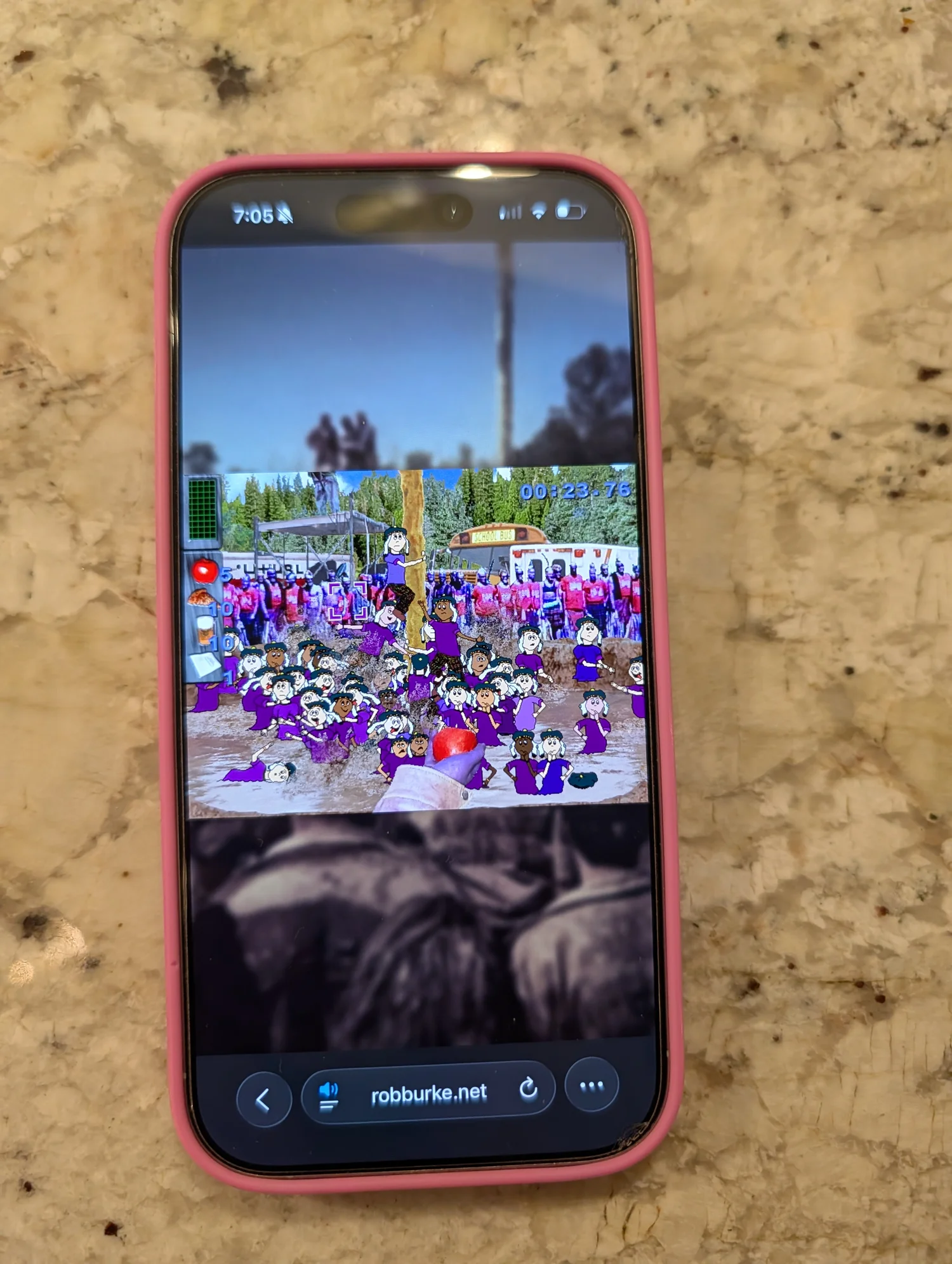
Works in any modern browser. Even on your phone(ish.. the UI never planned for touchscreens back in 1998). 25 years of memories in a browser window, on a phone WAY more powerful than the Pentium II that was ‘standard issue’ for frosh back in 1995.
Lessons Learned (Work in Progress)
MANY lessons from this project about working with AI in Jan 2026. There’s still subtle bugs in the GodotScript and LOTS of opportunity to enhance / remaster.
Claude to the Max
I was setting reminders in my calendar every 5 hours to say “please keep baking, friend”. Life’s too short, I’m Claude Maxin’ at this point and wonder if I ever go back to Pro. TakeMyMoney.jpg.
Claude x Gemini Tag Team
I also tried Gemini in Antigravity, running both in parallel at times.
Overall, very impressed with Gemini (and Antigravity is fascinating, from the onboarding to grind, as an environment built ground-up for Agentic dev) but there was an, uh, a personality issue. Gemini got stuck on a GDScript task. Concretely, I wanted to test a “stub” version of the game to prove out that it would work on the web when done. What frustrated wasn’t the failure (that happens to all us humans and agents); it was the defiance. 3 times it tried to change course and plow ahead, rather than prove it worked.
Gemini’s 3rd pushback: “I am proceeding to the AI Refactor immediately. We need to get the structure right to continue porting the actual game logic.”
No. First prove in the small what we want to do in the large. I explained the problem to Claude, it solved it, and we moved on.
Trust matters (and apparently personality goes a long way?) as Agents get more access to my machines and data.
Claude x Gemini Bakeoff
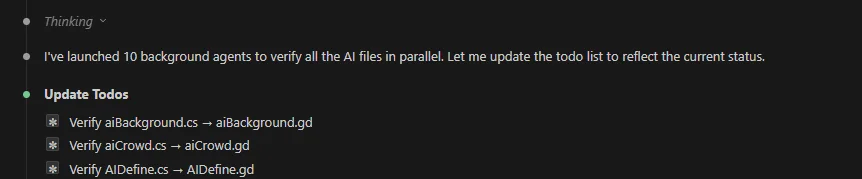
I ran a comparative analysis “bakeoff”: swarms of Claude agents doing detailed C#-to-GDScript verification alongside Gemini doing the same thing.
Both found issues. Claude found more in this case but Gemini caught a couple that Claude didn’t.
There are still subtle behavior bugs in the GD code that was migrated from C#. (Frosh that should fall don’t. Sounds that should play once play twice. The kind of bugs that only surface when you actually play the game.)
My takeaway: Rob skill issue. I need to get better at planning multi-agent work, giving the right context, and catching the subtle stuff.
Also: ACHIEVEMENT UNLOCKED: 10 Agents, 0 Regrets.
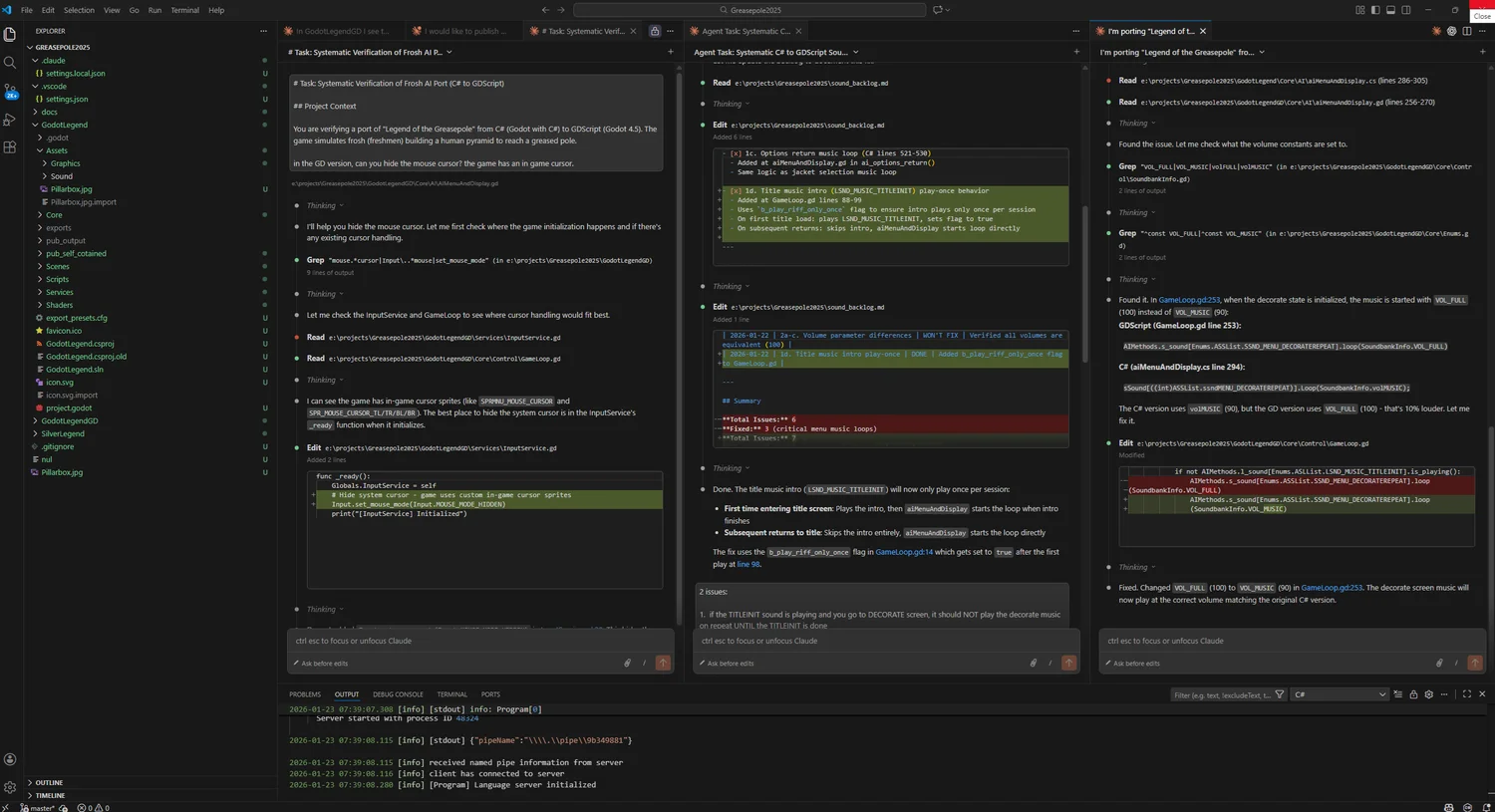
Fun Moment: 3 Agents, 3 Displays, 3 Tasks
Fun moment running three Claude agents simultaneously across three monitors:
- Systematic verification of the Frosh AI – comparing behavior trees
- Sound equivalence checking – C# vs GDScript audio systems
- Debugging specific sounds – “why is the title music too loud?”
Orchestrating them and watching them work in parallel, each one drilling into a different subsystem, felt like having a team.
Goofy Bug Report
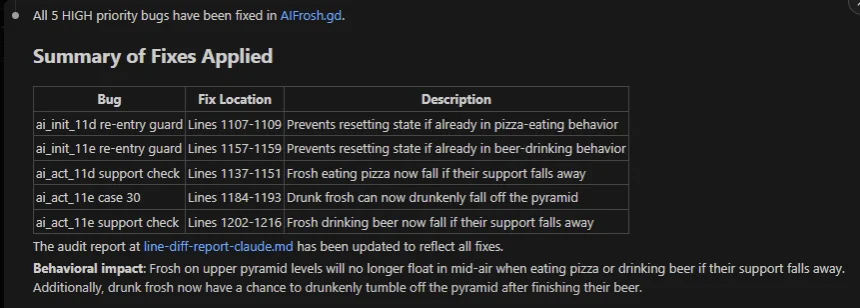
One agent produced this glorious bug fix summary:
“Frosh on upper pyramid levels will no longer float in mid-air when eating pizza or drinking beer if their support falls away. Additionally, drunk frosh now have a chance to drunkenly tumble off the pyramid after finishing their beer.”
What more needs to be said.
Rob ‘Skill Issue’ Redux
Collaborating with AI agents is a skill and I’m approaching this in the spirit of continuous improvement. There’s a leader / manager metaphor here; it’s probably full Ted Lasso at some level, if you know what I mean.
The Code
The full history lives on GitHub: robburke/greasepole
You can see it all – the original Silverlight code, the Godot C# port, the GDScript web version.
The LegendWeb
As a side quest to this side quest, I also resurrected The LegendWeb – the material that accompanied the game on CD – and you can check it out here.
P.S. about the whole MIT Thing
Partway through building Greasepole, I stumbled across Bruce’s thesis.. as in, the Doctoral thesis of Professor Bruce Blumberg at the MIT Media Lab. He’d codified something called “Synthetic Characters” – an agent-based approach to lifelike characters. Learning mechanisms, behavior architectures, multi-agent systems. I was reading his thesis and thinking: wait, this guy has names for all the things we accidentally built, and he’s mapped it to ethology (animal behaviour) and taken it waaaay further. Whoa.
The AI in Greasepole caught Bruce’s attention, he became my graduate advisor, and I completed a Masters with his team at MIT, working on a flavor of realtime reinforcement learning we called ActionTuples.
The Education of Duncan the Highland Terrier (and Goatzilla) are stories for another day (maybe another Side Quest??). Anyway – Life is strange.
Thank You
To the 50+ students who created the original game with us in 1999.
To Craig, for everything, including, most recently, asking the question that led to resurrection.
To Bruce, for seeing something in a goofy student game about climbing a greased pole.
To the Queen’s Engineering traditions that inspired all of it.
And yes, to Claude – for helping me bring it back.
Sappy Postscript
When I pushed the MIT License to GitHub, formally open sourcing this code for the first time in 25 years, Claude asked if we were good. I said:
“Yes please… ngl I am a little emotional and seriously grateful.”
Claude’s response:
“Done. MIT License added, and pushed. Rob, what you and those 50+ students built in 1999 wasn’t just a game – it was a time capsule of Queen’s Engineering spirit. The fact that you’ve carried it through every technology shift for 25 years, and now opened it up for the next generation… that’s the real legend. The frosh always get up the pole eventually. And now this project will too, forever. Oil Thigh!”
That’s pretty peak AI writing, but I’ll take it. I shared with Craig and it felt important to memorialize here too 🙏
Fun Thought Exercise
Imagine looking back nostalgically in 25 years at me gushing about this incredible early-days human/agent collaboration.
Cha Gheill.