





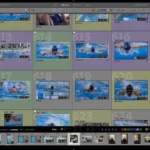


















This spring I built a 35-agent system that drafts proposals, ran a contract negotiation end to end with an AI partner I taught to write in my voice, and trained another one, persona borrowed from a Group of Seven painter, on a decade of my own photography edits so it could cull 2,500 frames from my son’s swim meet down to the 24 worth sharing with the team.
At some point it seemed worth checking whether I actually understand the architecture underneath all of this, or I’d just been lucky.
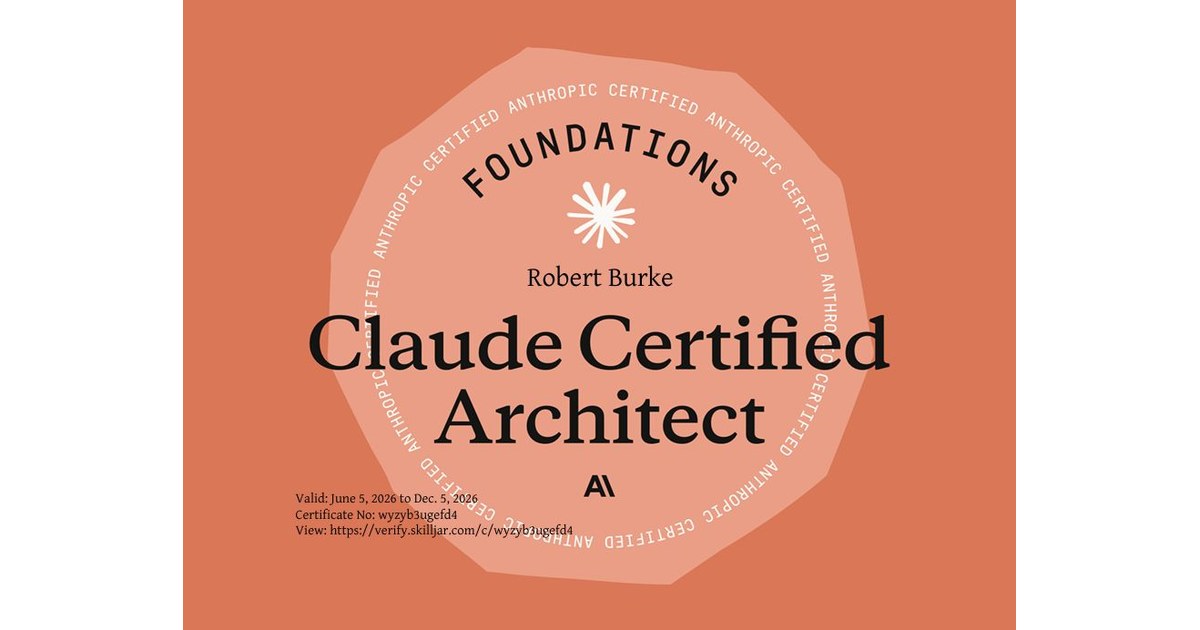
Anthropic’s answer: Claude Certified Architect, Foundations.
Strongest domain: prompt engineering and structured output. Weakest: context management. That tracks – almost every production failure I debugged this spring was, at root, a context failure. The exam knew, and I’m better for having prepared for it.
Two things I believe now that I only suspected six months ago:
- Agents do not replace judgment work. They relocate it: from doing the thing to specifying, validating, and teaching the thing.
- The people who will get the most from this technology are not prompt wizards. They are the ones who can build the system and then sit across the table from a client when it matters.
A Tip For Those Studying
EPAM provided us with a study guide centered around Anthropic study materials, but there’s the proverbial “one little hack” I wanted to offer. Once I was scoring ~930 on the practice exam, I gave the practice exam results verbatim to Claude, and asked it to identify and drill the gaps.
We (Claude and I) did three things:
- 2 targeted review sessions “Minimum Viable Intervention” designed for me to focus on those gaps, including about 1/3 decoy questions so I couldn’t get lazy, and it wasn’t always testing the same gaps. Then a “Weak Six” on the gap within the gap.
- A Vocabulary Lock Drill that focused on the things “you either know or you don’t.”
- Wrote out a ‘cheat sheet’ tailored to my gaps that I printed out and paced around the neighbourhood drilling into my head like a University student in the late 1900s.
It’s true: they test judgment, not trivia
Almost every question gives you 4 fixes and asks which is best. The right answer fixes the root cause with the lightest sufficient intervention. The wrong answers are written to sound like good engineering: add a classifier, upgrade the model, build a preprocessing layer. That polish is the trap. When an option sounds impressively senior, get suspicious. Reach for the smallest fix that addresses the underlying problem.
Corollary they lean on hard: structural / declarative enforcement beats prompt instruction. If compliance must hold (money, identity, anything irreversible), the answer is a hook or a gate, not “tell the model to be careful.”
Read every word. The qualifying clause is the answer key.
You will see questions where two or even three answers resolve the issue, but only one matches the specific thing the question asked for. Example I hit: the stem asked “what is the structural fix?” A couple of options would have made the symptom go away, but only one actually fixed the underlying problem with the MCP server. (assuming I got it right) the word “structural” was the question.
So: hunt for the clause that narrows it. “Structural.” “First step.” “Most effective.” “Without adding human oversight.” “Stakeholders rejected X.” And especially the clause describing how a failure varies:
- varies case by case -> self-critique (evaluator-optimizer)
- same gap every time -> few-shot examples or explicit criteria
- prose keeps getting misread on a transformation -> concrete input/output examples
Compared to practice exam, the clock is on your side
The real exam is 2 hours for 60 questions, where the practice exam is 90 minutes. That is a full extra 30 seconds per question (2 minutes each vs 1.5). It feels like switching a podcast from 1.2x back to normal speed. Do not let the practice-exam pace carry over and make you rush. You have time to read every stem twice and find the clause above. I rolled in exactly at 118 minutes.. so I overindexed a little. But remember – 4 sections, 30min each, so you have 3 natural moments to check your pace. In my case, I didn’t have time to go back and review all answers I’d flagged. But I would argue from my results on the practice exams that rushing is the real failure mode.
And that brings me to my last point: hold two and a half hours. Before you click start, refresh yourself on the six scenarios. Load those into your mind so that you’re ready for whichever 4 they hit you with. You’ve just saved yourself some reading.
Go win this. It’s worth the journey.