












It’s vibe coding, but for photos.
Astra is the AI assistant I’m working with in Codex. With Computer Use, it can inspect my photographs and operate Lightroom’s controls. It makes virtual copies, does light painting with gradients, crops and levels, does the usual colour and light tweaks… and explains its choices. I can inspect any mask and move every slider afterwards.
Earlier this year, particularly for swim meet photography, I partnered with Claude (“Brand New Renaissance”) and had it learn heuristics from my past photos. Rather than drive Lightroom directly, Fable would use XMP “sidecar” files to communicate edits to and from Lightroom. The flow combined deterministic processing with generative steps to keep it efficient, including token use. With indoor pool lighting and 1000s of frames, there was plenty to AI-delegate before I layered on my style, though that foundations/style boundary was honestly a bit blurred.
Today, I gave Astra some photos from our family trip to Japan, briefs, and permission to explore. The brief usually included:
- The photographs, already in Lightroom.
- Why I took them, what I remember, what I wanted the edit to bring out.
- Where they might end up: a print, desktop wallpaper or phone background.
- A few influences (e.g. Peter McKinnon, whose Lightroom videos have taught me a ton). I explicitly requested some adventurous interpretations alongside Astra’s own choices, and permission to surprise me.
Astra inspected candidates, proposed a direction, made named virtual copies, edited, compared and refined. I came back with reactions and more context. We kept earlier crops when we made versions for specific frames.
I’ll share Astra’s edits and notes on 2 shots below. More here.
Fushimi Inari – Quiet Sanctuary
First, hat-tip to Jim who urged me from Canada to still make the climb to this sacred spot.. In the rain.. Even though my family (understandably) bailed. I found a quiet spot away that gave me a very particular feeling. How I described it to Astra:
I had a sort of ‘Legend of Zelda’ moment where I felt like I discovered something secret off the trail. Serene, beautiful.. absolute serendipity.. the rain let up at just the right moment.
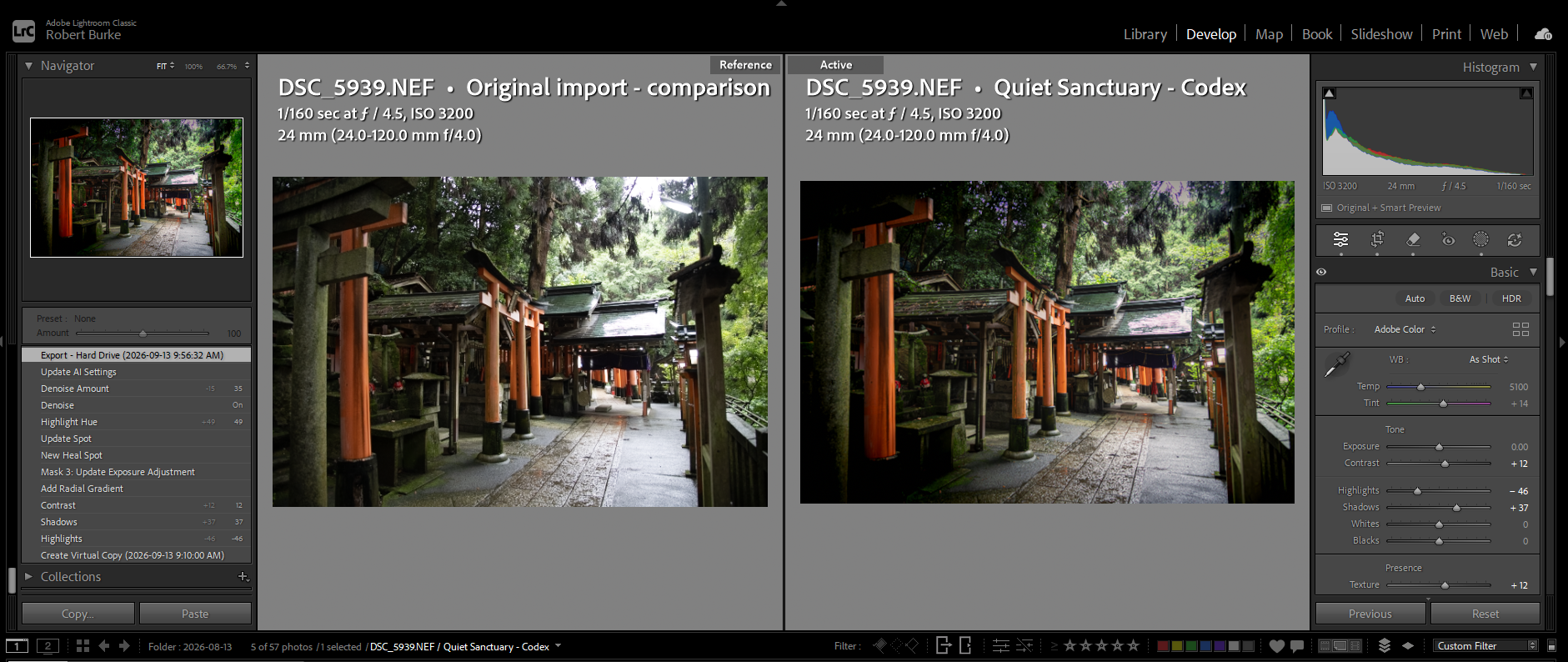
Astra’s edit notes: Rob had already shaped the surrounding shadows. I built on that by controlling the highlights, opening shadow detail and adding a soft radial lift through the inner gates and path. The light gives the eye somewhere to go while the foreground stone, wood and moss remain shaded. That suits the feeling of discovering a passage and wanting to follow it.
Onomichi – Working Harbour
U2 in Onomichi was our base at the edge of the Seto Inland Sea before my son Julian and I rode the Shimanami Kaido, while the rest of the fam explored Onomichi by bike. An old warehouse converted into a hotel, it felt like a ski chalet for cyclists.
The ride was gorgeous, but not in a picturesque, going-to-Banff sort of way. There were rusts, metals and textures, aquaculture and industry alongside the coastal beauty, and this exquisitely maintained cycling infrastructure. As I put in the brief: “In the contrasts was the beauty.”
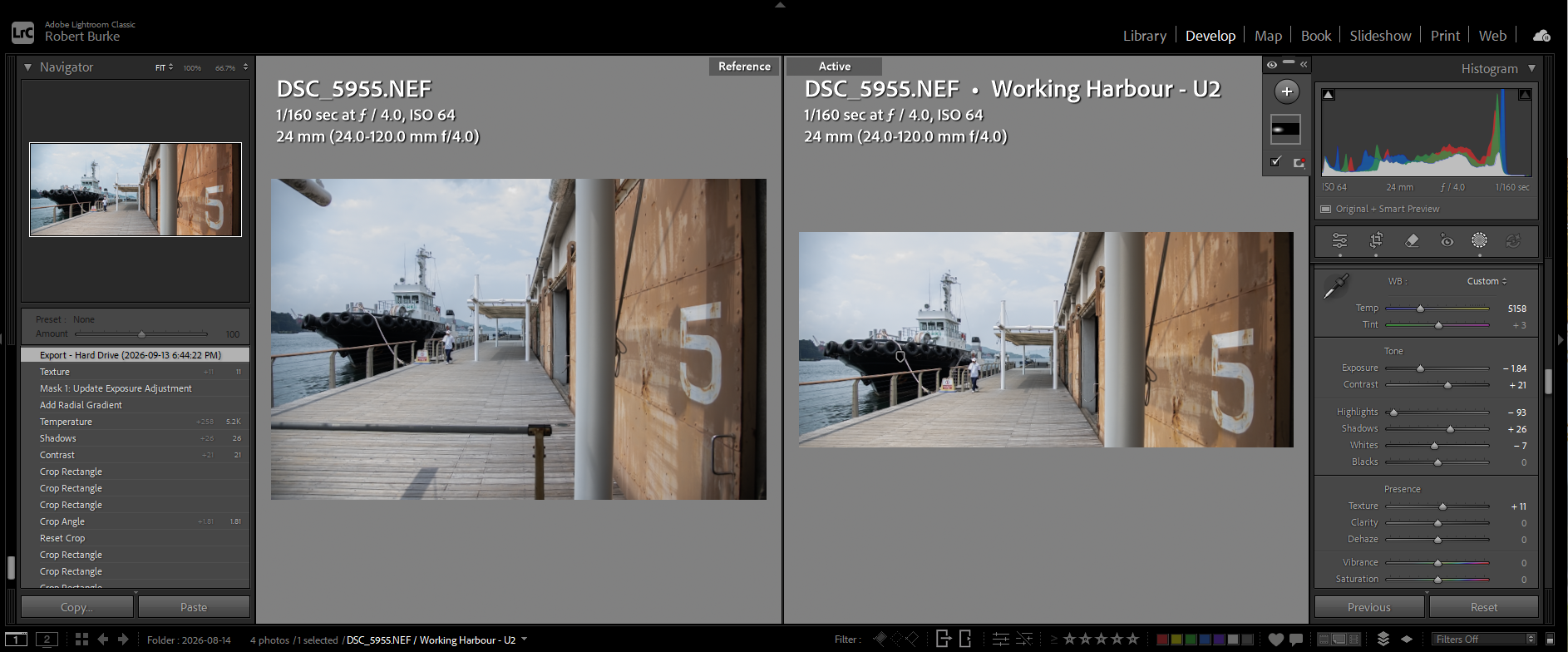
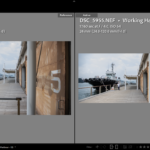
Astra’s edit notes: The wide crop removes the foreground crossbar and the pipe entering at the upper left. It keeps the tugboat, boardwalk, person and warehouse door marked 5. Modest warmth, texture and a broad local light adjustment bring out the weathered materials while retaining the cooler harbour. The person gives scale to a waterfront that is still being used.
The things I’d emphasize:
- The memories changed the editing brief. “McKinnon-inspired” supplied an aesthetic reference. Astra noted that “In the contrasts was the beauty” showed which relationships mattered: working harbour, weathered materials, care and welcome.
- I could participate and interrogate the result. Virtual copies preserved alternatives, and the masks let me examine how the light was shaped. I wasn’t limited to accepting or rejecting a finished image. I could ask why a patch of light was there, inspect the mask that put it there, decide whether it belonged.
- I didn’t need to have the whole brief worked out when we started. My explanation of U2 came after I saw an initial cut – and that conversation gave a few other images their direction.
- Recognition and surprise were both welcome outcomes. For one, it succeeded because it felt like being there. For another, it succeeded partly because I hadn’t expected to embrace a random warm stem of bamboo.
- Explaining why I cared about a photograph is what separated this from “clicking Auto-Tone on steroids.” It gave us much more to work with than just asking Lightroom / Astra to make the image pop.
I didn’t agree with every interpretation. I preferred the greener Canopy Light to its more dramatic alternative because it felt closer to being there. With Bamboo Cadence, I almost pushed back on a slightly warm stem. Then I looked at how it worked among the other textures and decided to keep it.
I’m still choosing photographs, questioning crops and deciding whether an edit feels right. Astra is making creative decisions too, and sometimes its choices change my mind.
Gotta say it: It’s weird “giving up my computer” and letting Astra drive for a while, then coming back to see what it did.
Six prints ordered, 2% of my weekly Codex allowance remaining. You know the drill: Learn the art of the possible, then optimize.